Geometry proof
This problem is adapted from problem #15 in section 3.4 of
Rhoad, R., Milsaukas, G., & Whipple, R. Geometry for Enjoyment and Challenge (New Edition). McDougal Littell, 1991. Page 137.
All references to theorems are taken taken this text.
Problem:
Given the figure

and the statements
$\overline {AB} \cong \overline{AC}$
$\overline {BD} \cong \overline{CE}$,
Prove: $\angle ABC \cong \angle ACB$
Comment: This could be proved in a single step using Theorem 21 (page 149) "If two sides of a triangle are congruent, the angles opposite the sides are congruent." However, this theorem will not be proved until a later chapter, so we must arrive at our proof by different means.
Historical note: This problem as actually a disguised version of the "pons asinorum" (or "Bridge of Asses") proof from Euclid's Elements. In that problem only the $\triangle ABC$ is given, and the the student must prove that if it is isosceles then its base angles are congruent. The proof given is surprisingly complex (though simpler proofs are known); hence it was said to separate the students who could understand it from the "asses" who could not.
Solution:
| Statement | Justification | |
1. 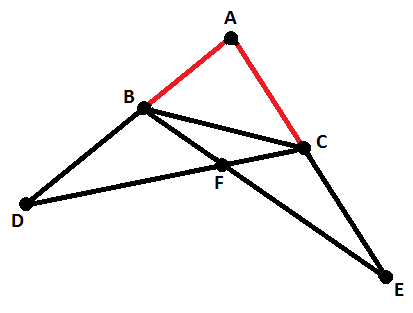 |
$\overline {AB} \cong \overline{AC}$ | Given |
2. 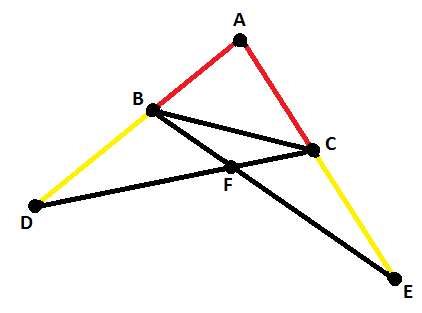
| $\overline {BD} \cong \overline{CE}$ | Given |
3. 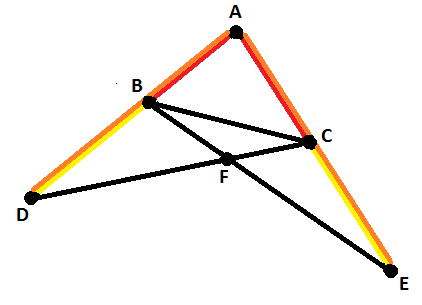
| $\overline {AD} \cong \overline{AE}$ | Addition Property (1, 2) |
| 4. |
$\angle A \cong \angle A$ | Reflexive Property |
| 5. |
$\triangle ADC \cong \triangle AEB$ | SAS (3, 4, 1) |
6. 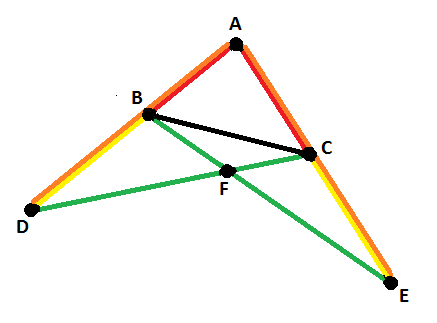 |
$\overline{DC} \cong \overline{EB}$ | CPCTC (5) |
7. 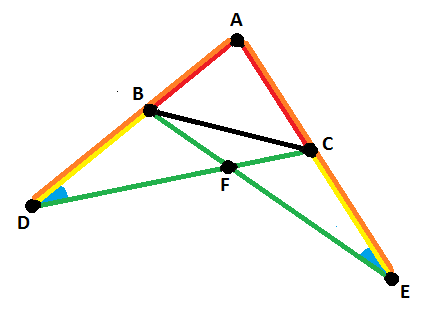 |
$\angle D \cong \angle E$ | CPCTC (5) |
| 8. |
$\triangle BDC \cong \triangle CEB$ | SAS (2, 7, 6) |
9. 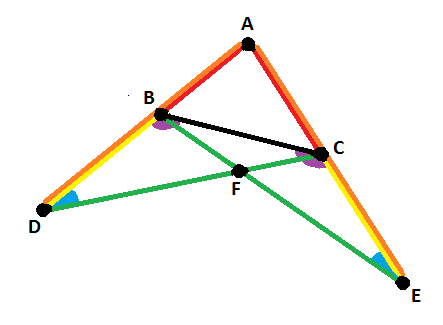 |
$\angle DBC \cong \angle ECB$ | CPCTC (8) |
| 10. |
$\angle DBC$ is supp. to $\angle CBA$ | Def. of supp. $\angle$'s |
| 11. |
$\angle ECB$ is supp. to $\angle BCA$ | Def. of supp. $\angle$'s |
| 12. |
$\angle DBC$ is supp. to $\angle BCA$ | Substitution (9, 11) |
13.  |
$\angle CBA \cong \angle BCA$ | Transitive property (10, 12) |
Q. E. D.